



Leptomeningeal Metastasis: Current Treatment, and Emerging Therapies
Zain Jandial
University of California, Berkeley, Berkeley, CA, USA.
Rachana Garg *
Department of Biology, Division of Mathematics and Natural Science, Allen University, Columbia, South Carolina, United States of America.
Ashvin Kumar
Department of Biological Sciences, University of Chicago, Chicago, IL 60637, United States.
Mike Chen
Division of Neurosurgery, City of Hope and Beckman Research Institute, 1500 East Duarte RD, MOB 2001, Duarte-Los Angeles, CA 91010, USA.
*Author to whom correspondence should be addressed.
Abstract
Leptomeningeal carcinomatosis (LC) is a rare but devastating manifestation of cancer that has undergone metastatic spread to the cerebrospinal fluid and leptomeninges. The most common malignancies associated with LC are melanoma, breast, and lung cancers. LC severely influences morbidity and mortality, with a mean survival time of 2-6 months. Although characterized nearly 150 years ago, LC remains incurable as there are limited therapeutic options, and there is a considerable risk of treatment-related toxicities. Hence, there is an urgent need for thorough characterization of disease pathogenesis to determine novel therapeutic targets and strategies to reduce LC burden. Here, we review the current understanding of the molecular landscape of this disease and highlight recent advances in LC diagnosis and therapy.
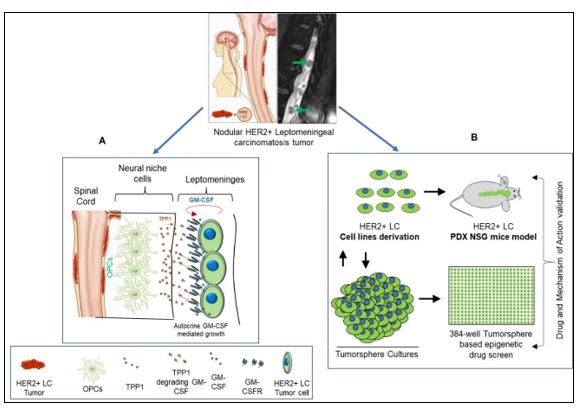
Graphical Abstract.: (A) Interaction between the breast cancer cell-secreted cytokine GM-CSF and the OPC-derived protein TPP1 within the leptomeningeal environment modulates Her2+LC growth and metastasis. (B) Derivation of primary Lepto cells, their implant in the PDX mouse model, isolation of cells, and subsequent culture to carry out the drug screen assay.
Keywords: Leptomeningeal carcinomatosis, HER2 breast cancer, metastasis, targeted-therapy, GM-CSF, KDM4A/4C